Blog
The Costa Rica Cost of Living Lie
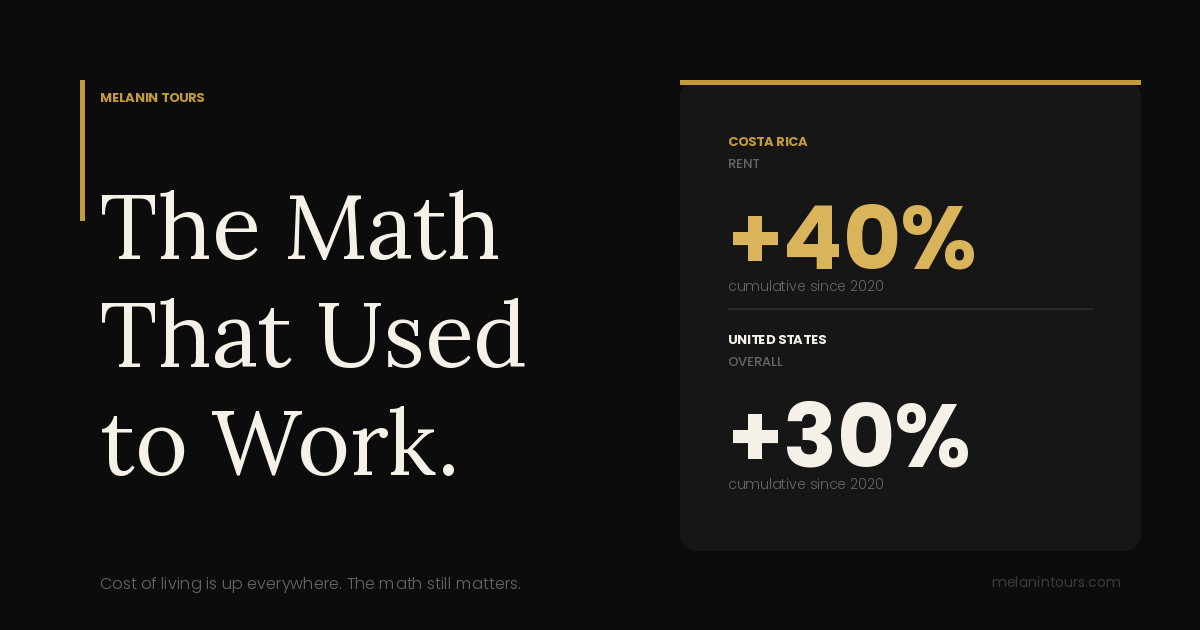
The outdated $1,500/month Costa Rica story keeps circulating. It gets copied, shared, and repeated until it feels like a fact. But for most Americans trying to build a stable life here in 2025 and 2026, that number is missing too much of the real math.
For over a decade, blog posts, YouTube videos, and expat forums have repeated the same claim: you can live comfortably in Costa Rica on $1,500 to $2,000 per month.
It is not fact. It is a figure rooted in outdated data, selective budgeting, and in many cases, the omission of costs that do not fit the narrative.
The people promoting this number are often selling something: a relocation course, a real estate consultation, or an affiliate link to an expat health insurance program. They benefit when Costa Rica sounds affordable. You pay the price when reality hits.
Where the $1,500 Number Comes From
The $1,500/month figure comes from budget breakdowns written primarily between 2012 and 2018. During that period, Costa Rica was genuinely more affordable relative to the US dollar. The colon was weaker, rents outside the Central Valley were lower, and the expat infrastructure around imported goods, international schools, and private healthcare was less developed.
Since 2020, Costa Rica has experienced significant inflation. Remote work migration from the United States helped drive up rents in desirable areas. Supply chain disruption increased the cost of imported goods. New tax structures affected businesses and, indirectly, consumer prices.
By 2025, the $1,500/month budget is only achievable under a very specific set of conditions that are rarely stated clearly upfront.
What a Realistic Budget Actually Looks Like
Housing
San Jose: A one-bedroom apartment in a safe, centrally located neighborhood like Escazu, Santa Ana, Curridabat, or Rohrmoser runs between $700 and $1,200 per month. Budget areas closer to downtown can be found for $400 to $600, but they come with tradeoffs in safety, infrastructure quality, and noise.
Pacific Coast: Tamarindo, Nosara, Jaco, and Santa Teresa have seen dramatic rent inflation driven by tourism and remote work. A modest one-bedroom in Tamarindo now runs $800 to $1,500. Nosara regularly sees one-bedroom units listed at $1,200 to $2,000.
Caribbean Coast: Puerto Viejo and Cahuita remain more affordable, with one-bedrooms ranging from $400 to $800, but infrastructure limits, flooding risk, and reduced access to services make the region unsuitable for many long-term residents.
The budget assumption: Most $1,500/month budgets assume rent of $400 to $500. In 2025, that price point is essentially unavailable in the areas most Americans choose for long-term life.
Groceries
Costa Rica has a dual-tier grocery system. Local markets, pulperias, Perimercados, and Maxi Pali can keep basic staples affordable. A household eating mostly local food can spend $200 to $350 per month.
But most American expats do not eat exclusively local food. The moment you add imported goods like cereal, peanut butter, specific cheeses, wine, olive oil, or processed snacks, the grocery bill rises sharply. Imported goods can be 40% to 100% more expensive than their US equivalents.
Realistic grocery budget: $300 to $600 per month depending on eating habits.
Transportation
Public buses are inexpensive but slow and not practical for many routes outside San Jose. If you rely on public transit exclusively, $50 to $100 per month is possible within the Central Valley.
If you own or rent a car, costs escalate. Vehicle import taxes are high, used vehicle prices are inflated, and fuel costs are materially higher than many Americans expect.
Car ownership estimate: $300 to $600 per month including payments or depreciation, insurance, fuel, and maintenance.
Utilities
Electricity can be manageable in the Central Valley, where many apartments do not need air conditioning. On the coasts, A/C changes the equation. A Central Valley apartment might pay $40 to $80 per month for electricity, while a coastal home running A/C can pay $150 to $300.
Water is generally $15 to $30 per month. Internet is commonly $35 to $60 per month in urban areas, though rural and coastal areas may have slower or more expensive service.
Total utilities: $90 to $400 depending on location and A/C usage.
Healthcare
Healthcare is the most misrepresented cost category in Costa Rica relocation content. CAJA, the public healthcare system, is available to legal residents, but enrollment is not immediate upon arrival. Contributions are income-based and can be meaningful for self-employed residents.
Many expats pay into CAJA, carry supplemental private insurance, and still pay out of pocket for private consultations because specialist wait times can be long.
Realistic healthcare budget: $300 to $600 per month unless you are young, healthy, and willing to rely entirely on the public system.
The Monthly Budget
| Category | Low End | Realistic Mid-Range |
|---|---|---|
| Rent | $700 | $1,100 |
| Groceries | $300 | $450 |
| Transportation | $100 bus | $400 car |
| Utilities | $100 | $200 |
| Healthcare | $300 | $500 |
| Dining and entertainment | $150 | $300 |
| Miscellaneous | $150 | $250 |
| Total | $1,800 | $3,200 |
This does not include travel back to the United States, language classes, pet care, clothing, personal care, childcare, school fees, or savings.
The Hidden Costs Nobody Includes
Vehicle import or purchase: If you ship a vehicle, expect to pay import duties of 52% to 79% of the vehicle's assessed value. If you buy locally, you pay inflated prices. If you rent long-term, a reliable vehicle can cost $800 to $1,500 per month.
The 90-day border run: People living on tourist status often do border runs to Nicaragua or Panama to reset their tourist stamp. That costs money, takes time, and immigration scrutiny has increased.
Residency application costs: Legal fees for a qualified immigration attorney can run $1,500 to $3,000. Apostilles, translations, and government fees can add another $500 to $1,500.
The rainy season reality: Roads flood. Humidity damages electronics and clothing. Mold becomes a real home maintenance issue. Many people underestimate both the inconvenience and the cost.
Currency fluctuation: When the colon strengthens against the dollar, dollar-denominated income buys fewer colones. Rising rents plus currency movement can change the budget faster than expected.
Who the $1,500 Budget Actually Works For
The $1,500/month lifestyle in Costa Rica is available to a narrow profile:
- Someone living in a rural or semi-rural area away from tourist zones and expat corridors
- Someone who does not own or need a car
- Someone who eats primarily local food
- Someone who is enrolled in CAJA and rarely uses private healthcare
- Someone with no dependents, no school-age children, and no pets
- Someone without regular travel needs back to the United States
This profile describes a small minority of American expats. Most people move to Costa Rica expecting a standard of living comparable to what they had in the US, in a safer and more affordable setting. That is a reasonable expectation. It simply costs more than $1,500 per month to achieve it.
The Bottom Line
Costa Rica is not the cheapest country in Latin America. It is not trying to be. It has positioned itself as a stable, democratic, ecologically rich destination with functioning infrastructure, quality private healthcare, and a welcoming environment for foreigners. That positioning comes with a cost.
Honest budgeting for a comfortable expat life in Costa Rica in 2025 starts at $2,500 per month for a single person and $3,500 to $5,000 per month for a couple or small family, depending on location, lifestyle, and healthcare needs.
Anyone telling you differently is either working from old data or working from an agenda.