I Lived Through a War. Now I Watch Them on the News Like Everyone Else.
On deploying to Iraq, running ammunition warehouses in Kuwait, and whether the Middle East is the next wave of expatriation.
Last week, a psychiatrist asked me how the news around the world was affecting me.
I laughed.
I told her I almost took a job in Qatar last year. And every time I start to regret not going, a bomb goes off somewhere in the region. So I suppose the news is doing its job—reminding me that timing is everything, and that sometimes the best decision is the one you didn’t make.
But here’s the thing about living abroad that people back home don’t understand: the news doesn’t follow you. In the U.S., you’re inundated with doom and gloom—24-hour cycles, push notifications, breaking news banners every time you open your phone. It’s relentless. Living overseas, it actually takes effort to stay up to date. You have to go looking for it. The world isn’t less chaotic—you’re just no longer sitting inside the machine that profits from making you feel like it is.
So when my psychiatrist asked how the state of the world was affecting me, the honest answer was: less than it probably should. And that’s not apathy. That’s distance. The kind of distance you can only get when you’ve physically removed yourself from a country that treats anxiety as a national pastime.
I’ve lived in five countries. One of them was an active combat zone. Another was the logistics hub feeding several more. And for most of my deployment, I felt less afraid in a war zone than most Americans feel watching the evening news. That changed late in our tour, when our camp started getting hit by rockets and RPGs every night of Ramadan. Fear found me then. But it was real fear—based on real danger, not a news anchor telling me the world was ending between commercial breaks.
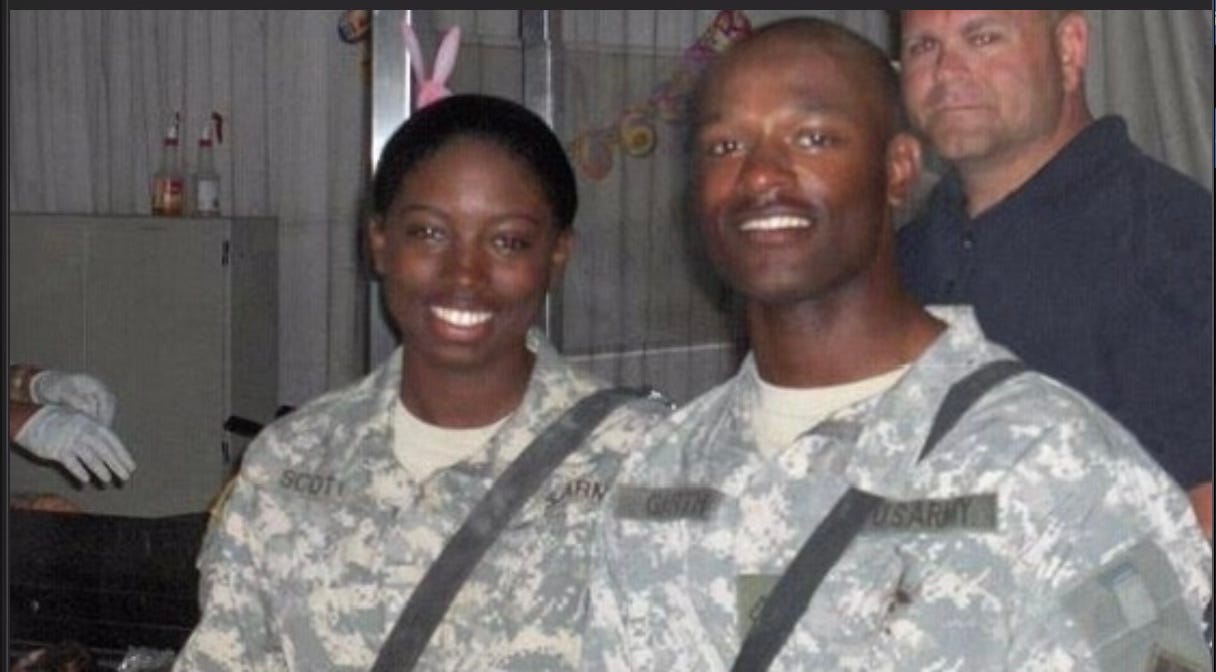
Najaf, Iraq. 2005–2006.
I deployed to Iraq in November 2005 with the U.S. Army. For most of my tour, I worked as the assistant supervisor of the Mayor’s cell on our base—managing billeting, key control, the day-to-day operations of keeping a small city running inside a war.
Living on a military base during active combat is surreal in a way that’s hard to explain to people who haven’t done it. Imagine a small American town—complete with a gym, a dining hall, a post office, a coffee shop—surrounded by concrete blast walls and razor wire. Inside the wire, people fall in love, break up, gossip, binge-watch bootleg DVDs, fight over who controls the TV in the MWR tent. Outside the wire, a war is happening.
It’s like living in a bubble. And most times, like living in a soap opera—except the stakes are real and the soundtrack is helicopters mounted with machine guns.
What Iraq taught me was that the human capacity for normalization is limitless. You can adapt to almost anything. Explosions become background noise. Danger becomes routine. And somewhere in that adaptation, you stop being afraid—not because the danger isn’t real, but because your nervous system simply runs out of bandwidth for it.
That lesson would serve me well in every country I’ve visited since. And here’s the thing—technically, Iraq was my first trip abroad. I didn’t even have a passport. The Army doesn’t need one to send you to a war zone.
Camp Arifjan, Kuwait. 2009–2010.
Two years after leaving the Army, I was back in the Middle East. This time as a defense contractor at Camp Arifjan, Kuwait, working for a joint venture that had been supporting the largest troop movement since World War II.
My job was to manage 21 ammunition warehouses supplying U.S. military forces across Kuwait, Afghanistan, Iraq, Djibouti, and other Middle Eastern bases while also supervising 20 workers across multiple facilities.
The workdays were 12 hours, six days per week, Saturdays off—the Kuwaiti weekend, not the American one. Around 6 months in, our workload picked up and we worked 7 days, 12-hour shifts. It took some getting used to. But the company recruiting materials didn’t lie about one thing: once you were in the groove, time passed quickly. You’d find yourself navigating Kuwait’s roadways without a map and rattling off military acronyms like you’d been born speaking them. The war in Iraq was drawing down, but the supply chain feeding Afghanistan, the Horn of Africa, and a dozen other operations was running full throttle. Kuwait wasn’t post-conflict. It was the logistics backbone.
The trade-offs were real. Tax-free earnings. Fully furnished housing. Company-provided transportation. A round-trip ticket to Frankfurt at your six-month mark. Access to the commissary, the PX, the library, the gym.
But outside the wire, Kuwait itself was full of contradictions I didn’t expect.
People-watching was practically a national sport—the recruiting materials literally called it that. They told you to grab a Turkish coffee at Al Kout Mall and join in. The malls were immaculate. There was massive investment in infrastructure and public works—gleaming roads and buildings rising from the desert. And then, right alongside them, mounds of trash on the side of the road. Daily. As if the ambition and the indifference existed on parallel tracks.
And here’s the line from the country briefing fact sheet that stuck with me: “Don’t forget, destinations such as Dubai, Abu Dhabi and Cairo are just an hour or two away by plane.” They were selling you the job, but they were also selling you the geography. Kuwait sat at the crossroads of everywhere. On my days off, I used it the way I’d later use Costa Rica—as a launch pad. A small country that punches above its weight because of where it sits on the map. I visited Dubai twice and Bahrain once—the most vacations I’d been on in one year up until that point in my life.
That’s when I started to understand something that would shape the rest of my life: where you live isn’t just about the place. It’s about what the place gives you access to.
The New Wave
Now I watch the Middle East from Costa Rica. Different hemisphere, same pattern.
War does something strange to economies. It increases production. It creates demand for infrastructure, for contractors, for logistics, for services. Money flows. Expat communities grow. I know—I was part of that machine. I managed the supply chain. I watched the contracts roll in. I saw how an entire economy of expat workers builds up around military operations, and I saw what happens to those people when the operations wind down.
The same cycle I lived through in Kuwait is happening again—new waves of people moving to the Gulf states, chasing contracts, building lives in places that most Americans only see on CNN.
And I wonder—as someone who’s been on both sides of it—what this new wave of Middle East expatriation looks like. Are people making informed choices? Do they understand what they’re signing up for? Have they thought about what happens when the contracts end and the region shifts again?
Because it always shifts.
I’m watching the same questions surface in real time. Friends asking about Dubai. Clients curious about Qatar. LinkedIn connections posting about new opportunities in Saudi Arabia. The money is real. The lifestyle is appealing. And the geopolitical risk is something most people are choosing to ignore because the paycheck is too good to think about.
I get it. I was that person once.
Should You Cut Back on Travel This Year?
Like a lot of people, I’ve been asking myself whether this is the year to stay closer to home. Not out of fear—I lost the luxury of irrational fear somewhere between Najaf and 12-hour shifts at Camp Arifjan—but out of practicality.
The world is reshuffling. Alliances are shifting. The places that felt stable five years ago don’t feel the same now. And the places that felt dangerous are, in some cases, reinventing themselves.
My honest answer? No. Don’t cut back on travel. But be smarter about it.
Understand the geopolitical landscape of wherever you’re going. Have contingency plans. Don’t chase opportunities in volatile regions without an exit strategy. And if you’re thinking about expatriation—whether it’s the Middle East, Latin America, Southeast Asia, or anywhere else—do it with your eyes open.
I’ve lived in five countries. I deployed to a war zone as a supply specialist at 22. I ran ammunition warehouses across the Middle East at 25. I retired and rebuilt my life on a beach in Costa Rica at 37. Every single move taught me the same lesson: the world is not as dangerous as the news makes it look, and it’s not as safe as your comfort zone makes you believe.
The truth is somewhere in the middle. And the best place to find it is from the ground, not from your couch.
If you’re thinking about your next chapter abroad—whether that’s retirement, relocation, or just a serious exploration—I write about this every week. The countries, the logistics, the real talk that nobody puts in the brochure.
Subscribe to The Global Retirement Plan and let’s figure it out together.